Time:2025-10-23
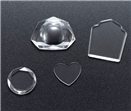
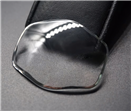
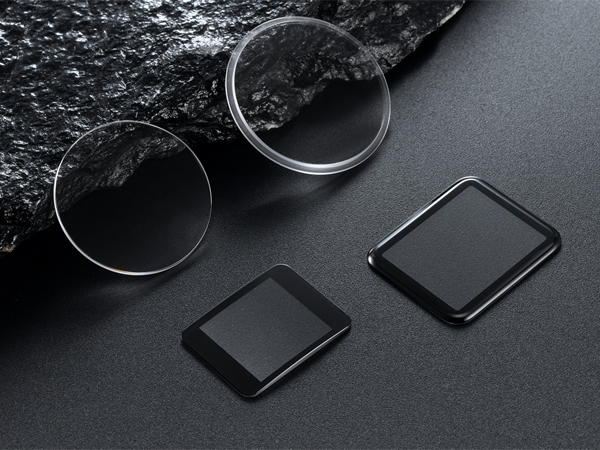
Sapphire window panels, as a high-performance optical material, exhibit excellent optical transmission properties in the ultraviolet, visible, and infrared bands. Their unique physical and chemical properties make them an ideal choice for harsh environments. This article will analyze the advantages of sapphire window panels from the aspects of material properties, optical performance, and application scenarios.
1、 Material characteristics and preparation process of sapphire
Sapphire (α - Al ₂ O3) is a single crystal form of aluminum oxide with a Mohs hardness of 9. Its melting point is 2053 ℃, thermal conductivity (about 35 W/m · K at 25 ℃), and coefficient of thermal expansion (5.3 × 10 ⁻⁶/K) are close to those of metals such as tungsten and molybdenum, which allows sapphire window plates to withstand severe thermal shocks. Crystals grown by Czochralski method (CZ method) or heat exchange method (HEM method) can obtain optical grade window plates with (0001) crystal orientation after directional cutting, and the surface roughness can be controlled below 0.5nm.
2、 Analysis of Wide Spectrum Transmittance Performance
In terms of optical transmission, sapphire exhibits a unique "dual band" characteristic:
1. Ultraviolet visible wave band (200-550nm): the transmittance can reach more than 85%, especially in the 250-400nm ultraviolet region, which is superior to fused silica. For example, in the application of 308nm excimer laser, the volumetric absorption coefficient of the 10mm thick sample is lower than 0.1cm ⁻¹.
2. Mid infrared band (3-5 μ m): maintaining a transmittance of over 80%, which is not achievable with ordinary optical glass. But there is an absorption peak caused by lattice vibration at 2.5-3 μ m, which needs to be suppressed by doping modification.
3. Limitations of far-infrared applications: After exceeding 6 μ m, the transmittance sharply decreases, and a strong absorption band appears at 7.5 μ m, which is related to the phonon resonance of Al-O bonds.
3、 Environmental stability performance
Comparative experiments show that under the same conditions:
1. Corrosion resistance: After soaking in concentrated hydrochloric acid (37%) for 24 hours, the surface erosion depth is only 0.02 μ m.
2. Radiation resistance: After being irradiated with 10 ⁶ Gy gamma rays, the transmittance at 380nm decreases by less than 2%, which is much better than radiation sensitive materials such as calcium fluoride.
3. Mechanical strength: The 4mm thick sample can withstand a quasi-static pressure of 1.5GPa, and can withstand a steel ball impact of 800m/s in dynamic impact testing.
4、 Typical application scenarios
1. High energy laser system: used as the output window for CO ₂ laser (10.6 μ m), with a power tolerance of up to 10kW/cm ².
2. Special environmental monitoring: The deep-sea probe uses a conical sapphire window with optical distortion less than 0.1 λ at a water pressure of 1100 meters, successfully achieving high-definition imaging of hydrothermal vents.
5、 Surface treatment technology
To optimize optical performance, the current main methods used are:
1. Broadband anti reflective coating: Designed with TiO ₂/SiO ₂ multilayer film system, achieving an average reflectivity of less than 0.5% in the 400-5000nm wavelength range.
2. Hydrophobic self-cleaning coating: The surface is modified with fluorosilane, with a contact angle of 115 °, significantly reducing dust adhesion.
3. Anti static treatment: ITO nanowire network is deposited on the surface, and the surface resistance is controlled at 10 ⁶ Ω/□, effectively preventing imaging noise caused by charge accumulation.
With the development of ultra precision machining technology, the wavefront distortion of sapphire window plates can be controlled within λ/10 (@ 632.8nm), which continues to expand their applications in cutting-edge fields such as astronomical observation and quantum communication.
Tel
Mobile phone
Customer service
TOP