Time:2025-12-25
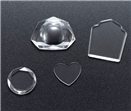
Sapphire glass, as a material, has demonstrated performance and broad application prospects in multiple fields. Its unique physical and chemical properties make it a darling of the industrial, consumer electronics, aerospace, and even luxury industries. The following will analyze the multifunctional properties and practical applications of sapphire glass from multiple dimensions.
1、 Physical characteristics
The Mohs hardness of sapphire glass reaches level 9, making it one of the most scratch resistant transparent materials currently available. This means that it can easily resist scratches from everyday items such as keys and coins, which is also the core reason why watch brands use sapphire crystal mirrors.
2、 Optical performance
Sapphire glass has a transmittance of 92% and a high refractive index of 1.76-1.77. This optical characteristic makes it perform excellently in camera lens protectors, observation windows, and other scenes, as it can maintain a clear field of view even in harsh environments. In addition, through coating technology such as AR anti reflective film, the reflectivity can be reduced to below 0.1%, which is crucial for reducing smartphone screen reflection and improving display performance.

3、 Chemical stability
It has strong resistance to acids, bases, and organic solvents, and even after soaking in concentrated sulfuric acid or strong alkaline solutions for 24 hours, its surface will not show significant corrosion. This feature makes it suitable for special environments such as observation windows in chemical equipment and pressure resistant windows in deep-sea detectors.
4、 Thermal properties
The melting point of sapphire glass is as high as 2053 ℃, and its thermal expansion coefficient is only 5.3 × 10 ⁻⁶/℃ (about 1/8 of ordinary glass). This thermal stability makes it an ideal material for high-temperature observation windows. For example, sapphire glass is often used for monitoring windows of industrial boilers and viewports of high-temperature experimental equipment. It is worth noting that although it is resistant to high temperatures, its thermal conductivity is about 35W/m · K, which may cause heat dissipation problems when used as a mobile phone screen. This is also one of the reasons why it has not yet been widely popularized in the consumer electronics field.
5、 Electronic characteristics
As an insulating material, sapphire glass has a resistivity of up to 1 × 10 ¹¹Ω· m and excellent microwave transparency. The combination of these contradictory characteristics makes it a key material for electronic components such as 5G antenna covers and radar covers.
6、 Processing technology
The difficulty of processing is the bottleneck for its large-scale application. Due to its high hardness, traditional cutting and polishing processes are inefficient and require the use of diamond cutting tools or laser processing.
From mirrors to observation windows in spacecraft, from precision instruments to smart devices on the wrist of ordinary people, sapphire glass is rewriting the boundaries of material applications with its "combination of rigidity and flexibility" characteristics. Its development trajectory confirms the balance between the pursuit of performance limits and practical value in materials science.Tel
Mobile phone
Customer service
TOP