Time:2026-01-14
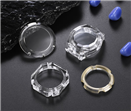
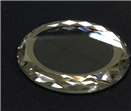
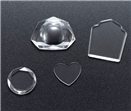
In the rapid development of technology and industry, materials science plays an important role. Sapphire glass, as an artificially synthesized material, is gradually becoming an ideal choice to meet specific optical needs due to its unique physical and chemical properties. This material not only inherits the high hardness, high transparency, and chemical stability of natural sapphire, but also achieves precise control of size and shape through artificial synthesis technology, making it valuable in many high-tech fields.
One of the striking features of sapphire glass is its extraordinary hardness. In the Mohs hardness scale, sapphire's hardness reaches level 9, making it an ideal choice for optical applications in extreme environments. In the aerospace field, aircraft need to withstand the impact of tiny particles in the air during high-speed flight. Ordinary glass will quickly show scratches and wear, while sapphire made portholes can maintain long-term clarity. Similarly, for optical equipment working in harsh environments such as deserts or polar regions, the protective layer of sapphire glass can effectively resist the erosion of wind, sand, and ice crystals, ensuring long-term reliable operation of the equipment.

Optical performance is another significant advantage of sapphire glass. This material has excellent transparency in the ultraviolet to near-infrared spectral range (approximately 150nm to 5500nm), with a transmittance of over 85%. For application scenarios that require precise color reproduction, such as camera lenses, microscope objectives, and spectrometer windows, sapphire glass can provide almost distortion free light transmission. In the field of laser technology, high-power lasers require window materials that can withstand strong laser beams without thermal deformation. Sapphire's high thermal conductivity and low absorption rate make it a choice. Especially in UV laser applications, ordinary optical glass will gradually darken due to UV irradiation, while sapphire glass can maintain long-term stability.
Chemical stability enables sapphire glass to perform well in corrosive environments, resisting the erosion of most strong acids and bases. Even under high temperature and pressure conditions, it is not prone to chemical reactions. This characteristic is particularly important in fields such as chemical process monitoring, deep-sea exploration, and semiconductor manufacturing. During the semiconductor wafer processing, the observation window made of sapphire can withstand the long-term erosion of corrosive gases and provide clear observation channels for operators.
From smartphones to space telescopes, sapphire glass is satisfying the pursuit of optical materials with its performance. As a material that combines hardness and transparency, it represents one of the pinnacle achievements of materials science. With the continuous advancement of technology and the increasing diversity of application demands, this magical material will demonstrate its unique value in more fields.Tel
Mobile phone
Customer service
TOP