Time:2025-12-10
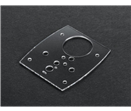
sapphire glassDue to its hardness and optical properties, it is widely used in fields such as watch mirrors and camera lenses. The double-sided grinding process is particularly critical in its manufacturing process, which achieves sub micron level surface flatness through precise control. The following is an analysis of this technology:
1、 Preprocessing stage
The raw material is made of Al ₂ O3 ingots, which are cut along the warp to form a substrate with a thickness of 0.5-1.2mm. Before entering the grinding process, edge chamfering is required, with the chamfering angle controlled at 30 °± 2 °, which can reduce the risk of edge fragmentation in subsequent processing. The cleaning process adopts a three-stage ultrasonic purification system, which sequentially uses acetone, deionized water, and isopropanol for degreasing treatment.

2、 Rough grinding process
Use diamond micro powder grinding solution (particle size W40-W28) with cast iron grinding disc, set the downforce to 0.15-0.2MPa, and maintain the speed at 80-120rpm. At this stage, it is necessary to maintain a coolant flow rate of 8-10L/min and a temperature control of 20 ± 2 ℃. After 120-180 minutes of processing, the surface roughness can be reduced from the initial Ra3.2 μ m to Ra0.8 μ m, and the parallelism error is less than 0.02mm.
3、 Key process of precision grinding
When entering the precision research stage, replace with resin based grinding discs and use diamond grinding paste (particle size W14-W7) combined with alkaline coolant with a pH value of 8.5. The equipment pressure drops to 0.05-0.08MPa and the speed increases to 150-180rpm. During this process, an online thickness monitoring system is used to automatically compensate for the grinding amount every 5 minutes, ensuring that the thickness tolerance is controlled within ± 0.005mm.
The grinding process is a crucial step in the processing of sapphire glass, which involves the rapid removal of surface damage layers through rough grinding, and the combination of fine grinding and chemical mechanical synergy to achieve high-precision leveling. The core lies in optimizing abrasive particle size, grinding pressure, and speed parameters to balance efficiency and surface quality, achieving mass production of sapphire glass.Tel
Mobile phone
Customer service
TOP